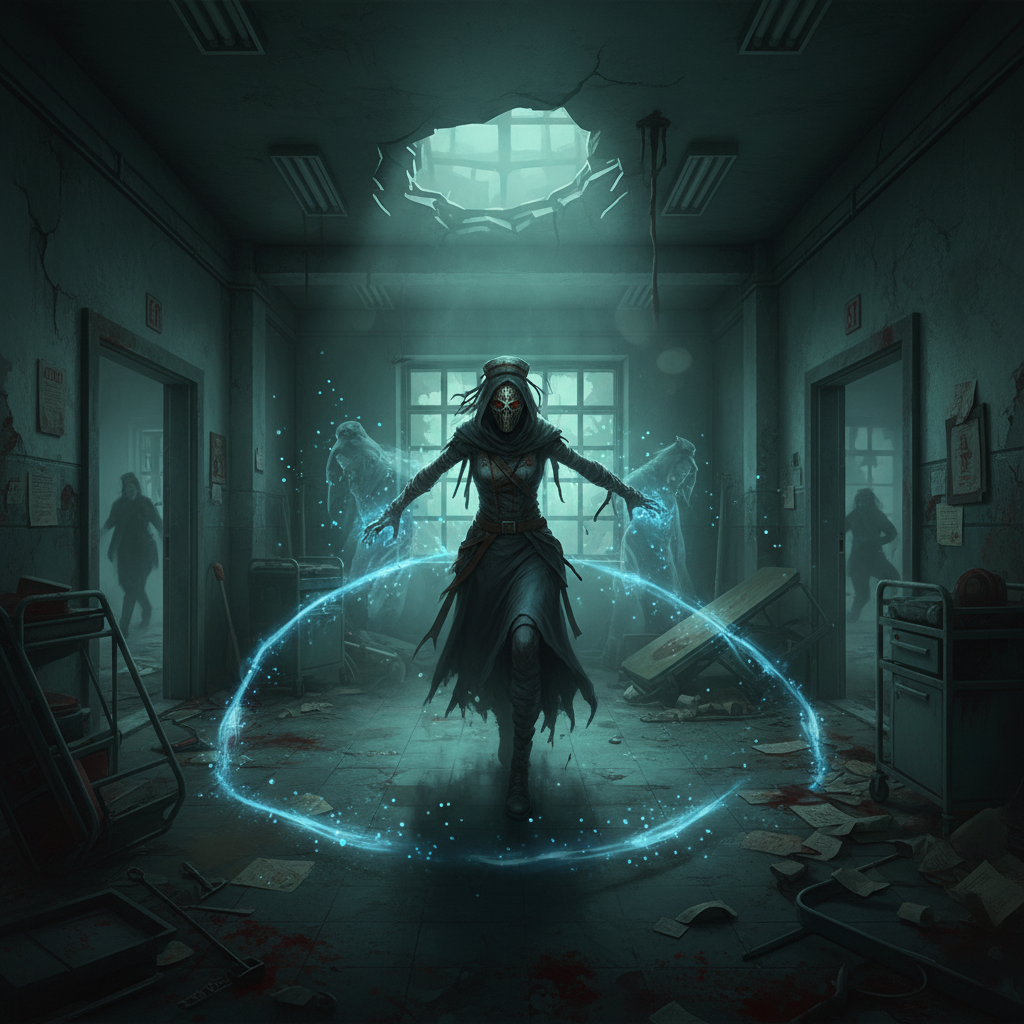
The Nurse’s blink mechanics involve holding M2 to charge her “Spencer’s Last Breath” power for up to 2 seconds, then releasing to teleport, with the charge duration determining distance and allowing for up to two consecutive blinks before a fatigue state. To effectively use her power, predict survivor movement and aim to land hits by teleporting directly to their anticipated location, bypassing obstacles.
Blink Mechanics Overview
The Nurse, Sally Smithson, possesses a unique power called “Spencer’s Last Breath,” which allows her to teleport, or “blink,” through objects and terrain. This ability fundamentally changes her gameplay compared to other killers, as she can ignore conventional chase mechanics like looping. By default, The Nurse has 2 blink charges that can be used consecutively. The first blink is typically used for repositioning or closing initial distance, while the second blink is often employed for the final approach and attack. Most successful plays involve utilizing both blinks to effectively close the gap and land a hit, as a single blink rarely results in a hit unless a survivor makes a significant error.
To activate a blink, players hold the M2 button to charge the power, with a maximum charge time of 2 seconds. Releasing M2 initiates the teleport in the direction The Nurse is facing. The duration of the charge directly influences the distance of the blink. After using blinks, or if too much time passes between blinks, The Nurse enters a “fatigue” state, which is a temporary stun. This power makes her the most unique killer in the game, requiring constant prediction and concentration from the player. Her default movement speed is 96%, but her blink movement speed is 333% without add-ons, highlighting her complete reliance on her power for mobility and chases.
Blink Distance and Travel Time
The distance The Nurse blinks is directly proportional to how long the M2 button is held during the charge. Developing muscle memory for specific charge times is crucial for precise movements and effective hits.
| Charge Time | Approximate Blink Distance (First Blink) |
|---|---|
| Short tap | 2-4 meters |
| 0.5 second hold | 8-10 meters |
| 1 second hold | 12-15 meters |
| 2 second hold | 20 meters (max) |
It’s important to note that follow blinks, if used, have a maximum range of 12 meters by default. Blinks are not instantaneous; there is a brief travel time during which The Nurse disappears from her starting location and reappears at her destination. This travel time varies based on the blink distance: short blinks take approximately 0.5 seconds, medium blinks around 0.8 seconds, and long blinks about 1.2 seconds. This non-instantaneous travel time is a critical factor, as survivors continue to move during this period. Therefore, players must predict where a survivor will be when The Nurse reappears, rather than where they are at the moment the blink is initiated. The direction of the blink is determined by where The Nurse is looking when M2 is released. For instance, looking up allows for vertical blinks through floors on multi-level maps, while looking down can be used for shorter blinks or to descend to lower floors.
Fatigue and Movement Speed
After utilizing her blinks or waiting too long between them, The Nurse enters a fatigue state. During this period, she is stunned for a duration of 2 to 3 seconds. The exact duration of fatigue depends on several factors: the number of blinks used (e.g., two blinks result in a longer fatigue than one), and whether she performed an attack (attacking adds to the fatigue time). A missed swing followed by fatigue results in a total of 5 seconds (3 seconds fatigue + 2 seconds attack animation). During fatigue, The Nurse’s movement speed is reduced to 96.5%, which is slower than survivors (100% movement speed). She cannot attack or use her power during this time, and her vision is impaired as she looks down at the ground.
The Nurse’s default movement speed of 96% means she cannot catch survivors by simply walking; she is entirely reliant on her blinks to close distances. If blinks are missed, survivors can gain significant distance. This makes her the slowest killer in the game without her power, emphasizing the necessity of mastering her blink mechanics. Managing fatigue is a key skill for Nurse players. After fatigue ends, her blinks begin to recharge, with one blink recharging approximately every 3 seconds. Instead of immediately blinking again, skilled players track the survivor’s movement during fatigue to plan their next blink effectively. The chain blink window, the time available to initiate a second blink after the first, is 1.5 seconds by default.
Advanced Blink Techniques and Chase Strategy
The Nurse’s chase strategy is fundamentally different from other killers; she doesn’t “chase” in the traditional sense but rather teleports to intercept survivors. The basic loop involves spotting a survivor, performing a first blink to get within 8-12 meters, observing their movement during the brief interval, and then executing a second blink to their predicted location for an attack. This prediction of survivor movement is the most challenging aspect of playing The Nurse.
Effective Nurse play involves understanding common survivor behaviors to anticipate their next move. For survivors running in a straight line, a common tactic is to blink behind them with the first blink and then forward with the second. When survivors attempt to “double back” (run one direction then quickly turn around), The Nurse can counter by using shorter blinks or waiting momentarily to confirm their direction before committing to a second blink.
Several advanced blink techniques can enhance a Nurse player’s effectiveness:
- Double-Back Blinks: Used when a survivor attempts to juke by reversing direction. The Nurse anticipates this and blinks to intercept their new path.
- Blink Faking: Charging a blink but not releasing, or releasing a very short blink, to deceive survivors into revealing their escape route.
- Vertical Blinks: Utilizing the ability to look up or down to blink through different floors on multi-level maps like “The Game.”
- Short Blinks: Executing very short, unpredictable blinks (2-4 meters) to catch survivors off guard, especially in tight areas or when they expect a longer blink.
- Omega Blinks: Maximizing the charge for a full 20-meter blink to cover large distances quickly or to reach survivors far away.
The Nurse’s power allows her to ignore all obstacles, making her immune to looping. This also grants her excellent mobility, making her strong at defending objectives like totems, generators, and hooks. Her ability to teleport into the basement from a distance makes her particularly effective in basement plays, allowing her to grab rescuing survivors. She also possesses strong ambush potential, capable of blinking onto generators from up to 32 meters away. Her strength lies in punishing cocky and over-altruistic survivors due to her unparalleled ability to close distances and bypass conventional survivor defenses.
FAQ
What is Spencer’s Last Breath? Spencer’s Last Breath is The Nurse’s unique power, allowing her to teleport (blink) short distances, ignoring all terrain and obstacles in Dead by Daylight.
How do I charge a blink? You charge a blink by holding down the M2 button. The longer you hold it (up to 2 seconds), the farther you will blink.
How many blinks can The Nurse use consecutively? By default, The Nurse can use up to 2 blinks consecutively before entering a fatigue state.
What is blink fatigue? Blink fatigue is a stun state The Nurse enters after using her blinks or waiting too long between them. During fatigue, she cannot attack or use her power, moves slower, and has reduced vision.
How far can The Nurse blink? A fully charged first blink can cover approximately 20 meters. Follow blinks have a maximum range of 12 meters.
Why is predicting survivor movement important for The Nurse? Blinks are not instantaneous; there is a travel time. You must predict where a survivor will be when you reappear, not where they are when you initiate the blink, to land hits effectively.
What is The Nurse’s movement speed? The Nurse’s default movement speed is 96%, which is slower than survivors. She relies entirely on her 333% blink movement speed to chase and down survivors.
Can The Nurse blink through walls and floors? Yes, The Nurse can blink through all in-game objects and terrain, including walls, pallets, and floors, by looking in the desired direction.