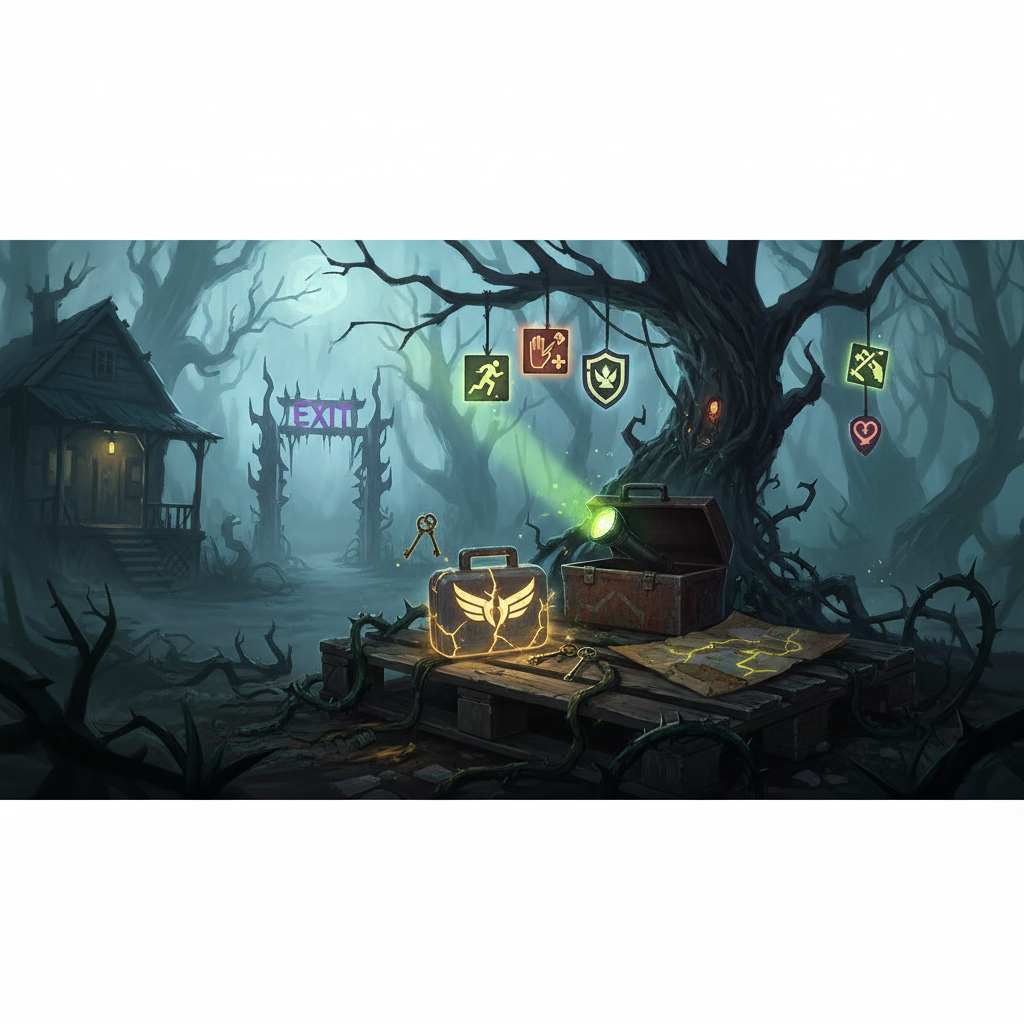
For the best all-around survivor build in Dead by Daylight, especially for solo queue, run Sprint Burst, Windows of Opportunity, Deja Vu, and Kindred. This combination provides an escape tool, resource knowledge, safer generator choices, and crucial hook-state information without needing team communication.
Quick Picks for Survivor Roles
As of September 2026, a strong survivor loadout provides a clear plan for various trial situations, offering useful information, distance in chases, protection after unhooks, or a defined role for coordinated teams. The best builds are those you can consistently operate under pressure, rather than a fixed tier list.
Here are quick recommendations for specific survivor jobs:
| Role | Build | Key Perks |
|---|---|---|
| All-Around (Balanced Solo) | Build 1 | Sprint Burst, Windows of Opportunity, Deja Vu, Kindred |
| Post-Unhook Protection (Anti-Tunnel) | Build 2 | Decisive Strike, Off the Record, Dead Hard, Unbreakable |
| Free Fundamentals (No-DLC) | Build 3 | Kindred, Deja Vu, Hope, We’ll Make It |
| Generator Pressure (Toolbox Skill-Check) | Build 4 | Hyperfocus, Stake Out, Deja Vu, Built to Last |
| Fun Pick (Locker Disruption) | Build 10 | Not specified in sources |
These quick picks are designed around distinct roles, acknowledging that no single four-perk set fits every player or situation. For instance, a chase-heavy build loses effectiveness on maps with poor vault access or after pallets have been used. Always review in-game perk tooltips before spending Bloodpoints, as live balance updates can alter effects, durations, conditions, and cooldowns.
Meta and Specialized Survivor Builds
The Dead by Daylight meta is dynamic, with perk effects and optimal strategies changing. The following builds are tested and verified as of July 15, 2026, offering strong options for various playstyles.
Balanced Solo Queue
This build, consisting of Sprint Burst, Windows of Opportunity, Deja Vu, and Kindred, is ideal for solo players seeking a practical loadout for most trials. Sprint Burst creates separation at the start of a chase, while Windows of Opportunity helps survivors route towards usable pallets or vaults. Deja Vu guides players to a safer generator spread, and Kindred converts hook states into actionable information for the entire team. This build addresses common problems without requiring perfect timing. A potential limitation is that preserving Sprint Burst can feel slow for players who prefer not to walk between objectives; those players might prefer Lithe.
Post-Unhook Protection (Anti-Tunnel)
For survivors frequently targeted after an unhook, the combination of Decisive Strike, Off the Record, Dead Hard, and Unbreakable provides multiple layers of protection. Off the Record offers a window of protection and aura concealment after being unhooked, though conspicuous actions can disable parts of this effect. Decisive Strike makes immediate re-downs costly for the killer, while Unbreakable grants one self-recovery opportunity. Dead Hard can extend a chase by turning a well-timed swing into more chase time. It’s crucial not to use this build as permission to body-block or immediately jump on a generator after a save; its purpose is to buy time for a reset and force the killer to make a target decision. It offers little objective value if tunneling isn’t occurring.
Toolbox Skill-Check Build (Generator Focus)
To maximize generator repair speed, this build uses Hyperfocus, Stake Out, Deja Vu, and Built to Last. It requires bringing a toolbox with appropriate add-ons. Stake Out provides reliable Great Skill Check value, which Hyperfocus then rewards with increased repair progression. Deja Vu prevents late-game “three-gen” situations by highlighting generator clusters. Built to Last can restore an item after its locker condition is met, extending the toolbox’s use. This build lacks chase safety, so planning an escape route before committing to a generator is essential. Its effectiveness diminishes if skill checks are frequently missed, no item is brought, or if a killer perk removes the toolbox.
Lithe Looping (Chase Focus)
For players who excel at learning tile layouts and practicing chases, the Lithe, Windows of Opportunity, Dance With Me, and Quick and Quiet build is highly effective. Lithe activates after a fast vault, providing a burst of speed, while Dance With Me briefly hides scratch marks at the start of this burst. Quick and Quiet removes the loud notification from fast vaults, further aiding evasion. Windows of Opportunity is crucial here, as it shows nearby pallets and windows, helping to plan a chase before the killer is directly on your tail. This build focuses on agility and evasion to stay ahead of the killer.
Beginner-Friendly and Free Builds
New players can start strong even without DLC characters. These builds focus on core mechanics and accessibility.
Free Fundamentals (No-DLC Learning Build)
This build, comprised of Kindred, Deja Vu, Hope, and We’ll Make It, is perfect for new players who are building their perk collection without needing teachable perks from DLC characters. Kindred makes a hooked teammate’s situation clear, preventing the common solo-queue issue of multiple survivors attempting the same save or no one going for it. Deja Vu helps prevent tight three-generator scenarios in the late game. We’ll Make It rewards safe rescues with rapid teammate healing, promoting altruism. Hope is reserved for the exit-gate phase, offering a speed boost during the endgame. While Hope won’t help in an early chase, this set teaches critical skills like generator spacing, hook timing, and when to prioritize objectives over saves. All these perks are general perks or come from base characters, making them fully accessible.
Solo Queue Build
A strong solo queue build, also largely accessible, includes Sprint Burst, Kindred, Deja Vu, and We’ll Make It. Kindred is the core of this build, providing vital information when another survivor is hooked by revealing other survivors and the killer’s proximity to the hook. When you are hooked, this information is shared with the entire team, helping prevent situations where multiple teammates abandon generators for one save, or no one moves at all. We’ll Make It complements this by allowing rapid healing of a rescued survivor after a safe unhook, assuming they don’t immediately run away. Sprint Burst is a Meg Thomas perk, while Kindred, Deja Vu, and We’ll Make It are general perks, meaning this build can be assembled without extensive DLC purchases.
FAQ
What is the best all-around survivor build for solo queue? The best all-around build for solo queue is Sprint Burst, Windows of Opportunity, Deja Vu, and Kindred. It offers an escape tool, resource information, generator guidance, and hook-state awareness.
What is the best build to counter tunneling? The best anti-tunnel build consists of Decisive Strike, Off the Record, Dead Hard, and Unbreakable. These perks provide multiple layers of protection and recovery after being unhooked.
Are there good survivor builds that don’t require DLC? Yes, the Free Fundamentals build (Kindred, Deja Vu, Hope, We’ll Make It) is a strong no-DLC option that teaches core game mechanics and is fully accessible.
How often do these builds get updated? This guide was last verified on July 15, 2026. Dead by Daylight changes quickly, so perk effects are based on the live client and Behaviour Interactive patch notes at that time.
What is a “meta” build in Dead by Daylight? A meta build is a popular and effective loadout that addresses common in-game problems, often providing useful information, distance in chases, or protection. It’s not necessarily a permanent tier list, but rather a set of perks that are highly functional in the current game state.